
Running a travel business is not only about creating beautiful tour packages, sharing amazing destination photos, or getting more visitors to your website. Behind every successful travel company, some numbers show what is working and what needs improvement. These numbers are called Key Performance Indicators (KPIs).
Key Performance Indicators (KPIs) for the travel business help companies understand their overall performance, customer behavior, marketing results, and booking growth. Without tracking the right KPIs, a travel business may spend time and money on strategies that are not bring real results.
For example, a travel agency may receive thousands of website visitors every month, but if those visitors are not making bookings, the business needs to understand why. Maybe the tour pages are not convincing enough, the booking process is complicated, or customers are leaving because they cannot find the information they need.
This is why tracking the right Key Performance Indicators for travel business is important. KPIs give travel companies a clear picture of their current situation and help them make better decisions for future growth.
What Are Key Performance Indicators (KPIs) for Travel Business?
Key Performance Indicators (KPIs) are measurable values that show how effectively a business is achieving its goals. In the travel industry, KPIs help businesses measure important areas like website performance, bookings, customer satisfaction, revenue growth, and marketing success.
A travel business has many moving parts. From attracting visitors through search engines and social media to converting those visitors into paying travelers, every step affects business growth.
For example, imagine a customer searching for a “Nepal trekking package.” They visit a travel website, check the tour details, read reviews, compare prices, and finally decide whether to book. Every action in this journey can provide useful data.
By tracking KPIs, travel businesses can understand:
- How many people are interested in their tours
- How many visitors become customers
- Which marketing channels bring the best results
- What customers like or dislike
- Where customers leave before booking
- How much revenue each tour generates
Instead of guessing what customers want, KPIs help businesses make decisions based on real data.
Why Are KPIs Important for a Travel Business?
The travel industry is highly competitive. Customers now compare multiple travel companies before making a decision. They check prices, reviews, photos, itineraries, payment options, and overall website experience before booking.
Because of this, travel businesses need more than attractive packages. They need to understand customer behavior.
For example, if a tour page receives many visitors but very few bookings, it shows that something needs attention. The issue could be unclear pricing, weak tour descriptions, missing trust signals, or a difficult booking process.
On the other hand, if a travel company knows that a specific trekking package gets more bookings through organic search, they can focus more on SEO and create similar content to attract more customers.
KPIs help travel businesses answer important questions:
- Are our marketing efforts working?
- Are customers finding our website easily?
- Which tours are performing best?
- Are customers completing the booking process?
- Are we growing compared to previous months?
These insights help businesses improve their strategies and create better experiences for travelers.
1. Website Traffic
One of the most important Key Performance Indicators for travel business is website traffic.
Website traffic shows how many people visit your travel website and where they come from. This helps businesses understand whether their marketing efforts are bringing attention to their services.
For example, a travel company may notice that thousands of people visit their website after searching for “Everest Base Camp Trek.” This shows there is strong interest in that service.
However, website traffic alone does not guarantee success. A website can receive high traffic but still generate fewer bookings if visitors do not find the information they need.
Travel businesses should look at:
- Total website visitors
- Traffic sources
- Most visited tour pages
- Time spent on pages
- Returning visitors
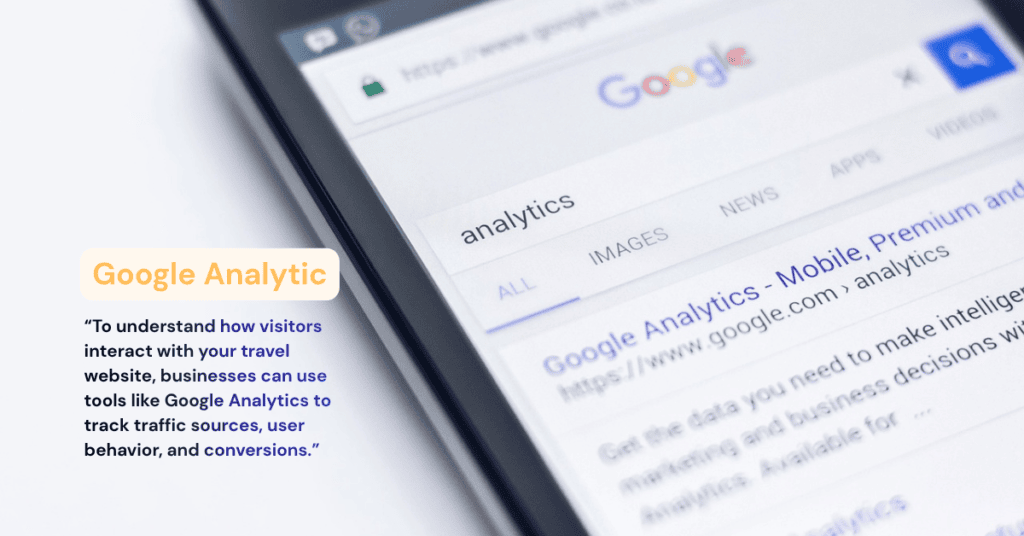
To understand how visitors interact with your travel website, businesses can use tools like Google Analytics to track traffic sources, user behavior, and conversions.
Add external link on Google Analytics:
https://analytics.google.com/
Understanding website traffic helps businesses improve their content, SEO strategy, and user experience.
2. Booking Conversion Rate
Getting visitors to your website is only the first step. The next important KPI is the booking conversion rate.
The booking conversion rate shows how many website visitors complete a booking compared to the total number of visitors.
For example, if 10,000 people visit your website and 200 people book a tour, your website conversion rate helps you understand how effective your website is at turning visitors into customers.
A low booking conversion rate may mean:
- Tour information is unclear
- Customers do not trust the website
- The booking process is difficult
- Payment options are limited
- Customers cannot find answers to their questions
A simple and smooth booking experience can improve conversions. Travel businesses using booking solutions like WP Travel Engine can organize tour details, pricing, availability, and booking steps in a way that makes it easier for customers to complete their journey.
When customers can easily understand a package and book without confusion, they are more likely to take action.
3. Average Booking Value
Average booking value is another important KPI for travel businesses. It shows the average amount customers spend on each booking.
This metric helps travel companies understand customer spending behavior and improve their revenue strategy.
For example, if most customers book basic packages, a business can create additional options like premium experiences, private guides, or extra activities.
A travel company can increase average booking value by offering:
- Upgraded packages
- Additional services
- Customized trips
- Premium experiences
Understanding this KPI helps businesses create better offers that match customer needs.
4. Customer Acquisition Cost (CAC)
Customer Acquisition Cost shows how much money a travel business spends to get one new customer.
For example, if a company spends $1,000 on Facebook ads and gets 20 bookings, the acquisition cost helps measure whether the advertising investment is profitable.
This KPI is important because attracting customers can be expensive. Travel businesses often invest in:
- Google Ads
- Social media marketing
- SEO
- Email campaigns
- Influencer marketing
If customer acquisition costs become too high, businesses need to improve their marketing strategy and focus on channels that bring better results.
5. Customer Lifetime Value (CLV)
Customer Lifetime Value represents the revenue a customer generates over the course of their relationship with a business.
In travel, repeat customers are valuable because one traveler may book multiple trips over time or recommend the company to others.
For example, a customer who books a trekking package today may return later for a cultural tour or adventure trip.
Travel businesses should focus on building long-term relationships through:
- Good customer service
- Personalized experiences
- Follow-up communication
- Loyalty offers
A happy traveler can become a returning customer and also bring new customers through recommendations.
6. Tour Package Performance
Not every tour package performs the same way. Some packages receive more attention and bookings than others.
Tracking tour performance helps businesses understand which products customers prefer.
Important things to measure include:
- Number of bookings
- Revenue generated
- Customer interest
- Page views
- Reviews received
For example, if a “7 Days Nepal Adventure Tour” gets more bookings than another package, the business can analyze why. Maybe the pricing is better, the description is clearer, or the destination is more attractive.
A well-written tour page helps customers understand the experience before booking. Read our guide on:
How to Write a Tour Description That Converts Visitors Into Bookings
7. Customer Reviews and Ratings
Customer reviews are one of the most powerful KPIs in the travel industry.
Before booking a trip, many travelers check reviews to understand the experience of previous customers. Reviews create trust and influence buying decisions.
A travel company should track:
- Number of reviews
- Average rating
- Customer feedback
- Common complaints

Positive reviews can improve brand reputation and encourage more bookings.
For example, a traveler choosing between two companies may select the one with more genuine reviews and better customer experiences.
8. Lead-to-Booking Ratio
Many travelers do not book immediately after visiting a website. They may contact the company, ask questions, or request more details first.
The lead-to-booking ratio helps measure how many inquiries become actual bookings.
If many people ask about tours but few complete bookings, businesses should check:
- Response time
- Communication quality
- Pricing clarity
- Customer support process
Quick and helpful communication can make a big difference in converting interested travelers into customers.
9. Website Bounce Rate
Bounce rate shows how many visitors leave a website after viewing only one page.
A high bounce rate may indicate that visitors are not finding what they expected.
For a travel website, common reasons include:
- Slow loading speed
- Poor design
- Lack of important information
- Weak tour descriptions
- Difficult navigation
Improving website experience helps visitors stay longer and increases the chance of booking.
10. Marketing Return on Investment (ROI)
Every travel business invests money in marketing. Measuring marketing ROI helps understand whether those investments are generating profit.
For example, if SEO efforts bring organic traffic that converts into bookings, the business knows that SEO is valuable.
Travel companies should compare:
- Marketing expenses
- Leads generated
- Bookings received
- Revenue earned
Travel businesses can measure website performance, search visibility, and customer journeys using tools like Google Search Console.
Add external link on Google Search Console:
https://search.google.com/search-console/
This helps businesses focus on strategies that create real growth.
11. Repeat Customer Rate
A repeat customer rate shows how many travelers return to book again.
Repeat customers are important because they already trust your service and usually require less marketing effort compared to new customers.
Travel businesses can improve repeat bookings by:
- Sending travel updates
- Offering returning customer discounts
- Sharing new destinations
- Maintaining good relationships
A positive travel experience often creates long-term customer relationships.
12. Social Media Engagement
Social media is a major part of travel marketing. Beautiful destinations, customer stories, and travel videos can attract potential travelers.
However, likes alone do not always mean business success.
Travel businesses should track:
- Website clicks from social media
- Messages received
- Shares
- Saves
- Booking inquiries
The goal is not only to get attention but to turn interest into real customers.
How Travel Businesses Can Use KPIs for Growth
Tracking KPIs is useful only when businesses use the information to improve.
For example, if a travel company notices that customers leave during the booking process, they can simplify the booking steps.
If a specific blog brings many visitors, they can create more useful content around that topic.
If customers love a particular tour package, they can promote it more.
KPIs help businesses move from guessing to making informed decisions.
Final Thoughts
Key Performance Indicators (KPIs) for travel business are essential for understanding growth, customer behavior, and business performance. In a competitive travel industry, success is not only about attracting visitors but also about knowing what turns those visitors into happy travelers.
By tracking important metrics like website traffic, booking conversion rate, customer reviews, revenue, and marketing performance, travel businesses can improve their strategies and create better customer experiences.
A successful travel business grows by understanding its customers. Every click, booking, review, and interaction provides valuable information that can help improve future decisions.
With the right tracking system and tools that simplify booking management, travel companies can focus more on creating memorable journeys while building a stronger and more profitable business.


