
If you run a travel business, whether that’s a trekking company in Nepal, a safari outfit in Kenya, or a city tour operation in Barcelona, someone has probably told you to “get software.”
But the advice usually stops there. Nobody explains what tour operator software actually does when you have 14 booking emails, two overdue invoices, and a customer asking why their departure date changed.
This guide tries to fix that. No buzzwords, no fluff. Just a clear picture of what this software is, what it genuinely does for a travel business, what it won’t do, and how to figure out if you actually need it right now.
The Short Answer That Nobody Usually Gives You
Tour operator software is a digital platform that manages the operational and commercial side of running a tour business. It handles bookings, customer records, payment collection, availability calendars, and itinerary management in one place, instead of spread across your Gmail drafts, a WhatsApp thread, and a spreadsheet your cousin built in years ago.
That’s it. It’s not magic. It doesn’t sell tours for you. It doesn’t replace good customer service or strong relationships with your travelers. What it does is remove the manual overhead that grows like moss once your business gets past a certain size.
72% of travelers now prefer booking trips online instead of using a travel agency, and 80% want the option to complete their entire booking online.
This means tour operators without an online booking system may miss out on customers who prefer quick and easy digital bookings.
Why This Market Is Growing So Fast
Tour operator software wasn’t always a crowded category. Five years ago, most small operators managed with a booking form on their website and a spreadsheet. That worked when volume was low, and travelers had patience. Neither is true anymore.
In 2025, 72% of travelers said they preferred to book trips online, compared to only 12% who preferred using a travel agency. Think about that gap. Sixty percentage points between what travelers want and what traditional methods offer. The operators filling that gap are the ones capturing bookings. The ones who haven’t are watching customers leave their site after failing to find a clear “Book Now” button.
The global tour operator software market was valued at $756.5 million in 2025 and is projected to reach $2.2 billion by 2035, growing at a CAGR of 12.8%.
That growth isn’t coming from enterprise travel corporations. Much of it comes from small and mid-size operators who figured out that competing without software is like running a restaurant without a kitchen.
The market accelerated for a practical reason, too. The growth in this sector can be attributed to increasing digitization of travel services, expansion of online booking channels, rising demand for organized travel packages, and growing adoption of CRM tools.
Travelers expect a seamless booking experience. They expect instant confirmation. They expect a PDF itinerary in their inbox, not a “we’ll call you back to confirm” message.
What Tour Operator Software Actually Does
The term covers a wide range of tools, but most platforms worth using share a core set of capabilities. Here’s what they actually handle day to day.
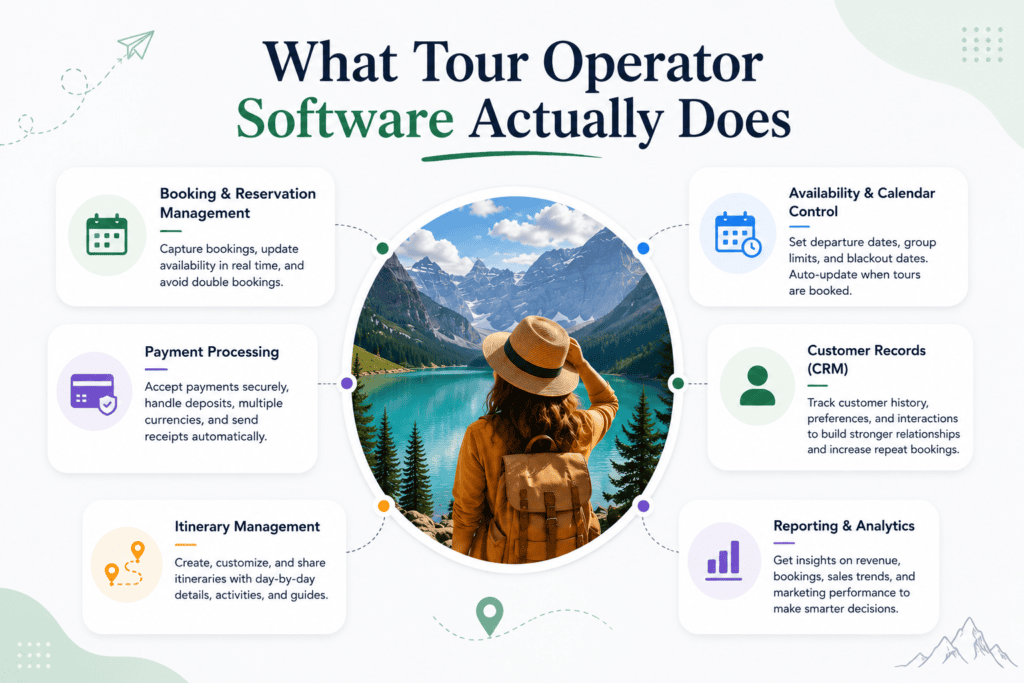
Booking and Reservation Management
This is the heart of it. Instead of manually logging inquiries and following up by email, the software captures bookings directly from your website, sends automatic confirmations, and updates your availability calendar in real time.
When someone books a 7-day Annapurna circuit trek for October, the seats disappear from inventory immediately. No double bookings. No awkward “sorry, we’re actually full” calls.
Approximately 64% of tour operators report managing more than 250 annual bookings through software-based systems, while 52% integrate payment processing and booking confirmation tools.
If you’re handling that volume manually, you already know what it costs you in time and mistakes.
Payment Processing
This one matters more than most operators expect when they first look at software. Collecting payments manually, through bank transfers, PayPal links, or cash on arrival, creates friction that costs bookings.
52% of travelers abandon a booking due to poor user experience. A confusing or slow checkout is a large part of that abandonment.
Good tour operator software integrates payment gateways directly into the booking flow, accepts multiple currencies, handles deposits versus full payments, and generates receipts automatically. You get paid faster, and travelers trust the process more when it looks professional.
Itinerary Management
Building itineraries manually for every booking is tedious and error-prone. Software lets you create templates once, then customize them per booking. Day-by-day breakdowns, accommodation details, activity schedules, guide assignments, all manageable from one screen.
Some platforms generate downloadable PDF brochures directly from the itinerary data, which travelers can read offline.
Availability and Calendar Control
If you offer tours with fixed departure dates, this matters enormously. You set the dates, the group size limits, and any blackout periods. The software handles everything from there.
It’s visible on your website, updates when people book, and closes automatically when a tour is full. No more manually editing your website every time something sells out.
Customer Records (CRM)
Every person who books with you is data that most operators waste. Their travel history, preferences, how they found you, whether they left a review.
Software that includes CRM functionality lets you track this, send follow-up emails, offer returning customer discounts, and generally treat people like they’ve been to you before, because they have.
Around 46% of tour operators use CRM modules to manage repeat travelers. Repeat customers cost less to acquire than new ones. The operators who understand that invest in actually remembering who those customers are.
Reporting and Analytics
At the end of the month, do you know which tour type generates the most revenue? Which departure dates sell out fastest? Which traffic source converts best?
If you’re running everything manually, you probably don’t, or you know only because you manually counted it. Software gives you a dashboard that shows this at a glance, which changes how you make decisions about pricing, marketing, and capacity.
What It Won’t Do For You
Let’s be clear about the limits, because software vendors rarely are.
Tour operator software won’t generate demand. You still need marketing, content, SEO, and social proof to bring people to your website. The software handles what happens after they arrive, not before.
It won’t fix a bad product. If your tours are poorly designed, overpriced, or poorly reviewed, no amount of booking automation will turn that around. The software makes a good operation run smoother. It can’t substitute for the core quality of what you sell.
And it won’t replace the human relationships that characterize the best tour businesses. Guides who know their terrain, operators who remember their repeat guests, local partnerships that give you access to experiences your competitors can’t offer. None of that lives in software. It lives in people.
That said, when the operational side runs without friction, you have more time for all of those things.
Who Actually Needs It (And Who Doesn’t)
Not every travel business needs enterprise software. A solo guide doing 40 bookings a year can get by with a simple contact form and a manual calendar. At that scale, the time saved by software might not justify the monthly cost or the learning curve.
But the calculus changes fast. Once you’re managing multiple tour types with different pricing, multiple guides, fixed departure dates, and more than a few hundred bookings a year, manual systems start introducing errors.
A double-booked departure. A payment that never got confirmed. A customer who never received their itinerary. These aren’t just inconveniences. Each one is a reputation risk.
Over 69% of operators prioritize workflow automation, while 47% focus on CRM and customer engagement tools. The pattern in that data is real. Operators who’ve felt the pain of manual systems don’t go back.
If you’re running your travel business on WordPress, the calculus is different again, because purpose-built tour booking plugins handle most of this natively, without requiring you to adopt a whole new platform.
WP Travel Engine, for example, was built specifically for this: tour listing, fixed departure dates, payment integration, multi-currency support, and automatic booking confirmations, all managed from your existing WordPress dashboard.
It powers over 20,000 travel websites and carries a 4.9 rating with 550+ five-star reviews on WordPress.org. For operators who already have a WordPress site, it’s the path of least resistance to a functioning booking system.
The Real Cost of Not Having One
Here’s a number that should matter to you: 81% of online travel bookings are abandoned before payment, often because of a clunky checkout or a lack of payment options. That’s not a small leak; it’s the majority of interested travelers walking away before they ever pay.
A lot of that abandonment comes down to friction. When a traveler can book instantly, without emailing back and forth or waiting for a manual confirmation, more of them follow through rather than losing interest or moving to a competitor who makes it easier.
When they’re stuck filling out a contact form and waiting for a reply, more of them simply leave.
Mobile is where this gap shows up fastest. 83% of travelers research trips on their phones, and 45% complete the entire booking process on mobile.
If your booking process requires someone to call you, fill out a multi-step form, or wait on an email reply, you’re losing mobile users at a rate you probably can’t see in your analytics because they leave before they convert, and an abandoned visit rarely shows up as a clear loss in your reporting.
The cost of not having software isn’t the subscription fee you’re avoiding. It’s the bookings that never happened.
Cloud vs. Self-Hosted: A Quick Distinction
Tour operator software comes in two main forms, and they serve different operator types.
Cloud-based SaaS platforms like Rezdy, FareHarbor, Checkfront, and Peek Pro are subscription services. You pay monthly (usually $49–$200+ per month depending on plan and booking volume), and the provider handles hosting, updates, and security.
The upside is low technical overhead. The downside is that you’re always paying, and your booking data lives on their servers. Some platforms also take a percentage of each booking on top of the subscription.
Self-hosted or CMS-integrated tools like WordPress plugins give you more control. You own the platform, the data, and the branding. The booking experience lives on your own website.
The tradeoff is that you handle the hosting and basic maintenance, though for any operator already running a WordPress site, that’s not additional complexity; it’s just using what’s already there.
There’s no universal right answer. A tour operator with 5,000+ annual bookings who needs enterprise-level reporting might find more value in a dedicated SaaS platform.
A mid-size operator running their business on WordPress who wants a clean, customizable booking flow and lower monthly cost often gets more from a plugin-based solution.
Key Features to Compare When Choosing
When you’re evaluating options, here’s what actually matters. Not the marketing language on the homepage. Not the number of features listed. These specific things:
Booking flow quality. Go through the booking process yourself as a customer. Count the clicks. Does it feel smooth? Does it work well on mobile? That experience is what your travelers will have.
Payment gateway options. Does it support the gateways your customers use? For international operators, Stripe and PayPal are the baseline. If you serve travelers from specific regions, check for local payment methods too.
Real-time availability. Can two people book simultaneously without conflict? This sounds obvious, but not all tools handle it cleanly.
Multi-currency and multilingual support. If your travelers come from multiple countries, you need pricing and content that respect where they’re from.
Integration with your existing site. A booking system that lives on your domain, matching your brand’s look and feel, converts better than a redirect to an external platform.
Customer support. Read the support forum or reviews. Not for the star rating. For how the company responds when something breaks.
A Word on What Travelers Actually Experience
It’s easy to think about this software from the operator’s side. Bookings, management, automation. But the traveler experience is where the real impact sits.
When someone decides to book a tour with you, they’ve usually already spent hours researching. They’ve read your reviews. They’ve looked at your photos.
They’ve compared you against competitors. By the time they click your booking link, they’re ready. What happens next determines whether you get the booking or they bounce.
A good booking flow confirms their choice. Clear pricing. Clear dates. A straightforward payment process. An immediate confirmation email with their itinerary.
That sequence builds trust in a way that no amount of marketing copy can. The booking process is your first operational touchpoint with a customer. It tells them more about how you run things than your About page ever will.
80% of global travelers say it’s important to be able to book their trips entirely online, with 86% of Millennials and 83% of Gen Z leading the charge. These are the travelers with disposable income right now and over the next decade. Their expectation isn’t “nice to have.” It’s baseline.
How to Start Without Overwhelming Yourself
One mistake operators make is trying to implement everything at once. They buy software, spend a week configuring it, confuse their website in the process, and conclude that it’s too complicated.
Start with one tour. Build the full booking flow for your most popular product. Test it yourself from end to end. Make sure payments work, confirmations are sent, and the calendar updates correctly. Live with that for a few weeks before adding more.
The operators who get the most out of tour booking software are not the ones with the most elaborate setups.
They’re the ones who built a clean, reliable system for their core offering and let it run. Once that’s stable, you can layer on additional features, more tour types, email automation, promo codes, and group booking management.
The Bottom Line
Tour operator software is not a luxury for large companies. It’s what separates a travel business that grows from one that stays the same size no matter how hard the owner works.
The market tells the story clearly. The global tour operator software market is expected to grow from $756.5 million in 2025 to $2.2 billion by 2035.
That’s not growth driven by big OTAs. That’s thousands of small and mid-size operators deciding, one at a time, that manual booking management is a ceiling they don’t want to keep hitting.
If you’re reading this because you’re trying to decide whether to make the switch, the honest answer is: for most businesses past a certain volume, the question isn’t whether to use software. It’s which one to use and how to implement it without disrupting what’s already working.
Ready to See What This Looks Like in Practice?
If you run your travel business on WordPress and you want a booking system that works without the monthly per-booking fees of platforms like FareHarbor or Rezdy, WP Travel Engine is worth a serious look.
The free version gives you tour listings, departure date management, customer inquiry management, and basic payment processing.
The paid plans start at $12/month and unlock multi-currency support, advanced pricing options, promotional codes, and deeper payment gateway integrations.
Start with the free version of WP Travel Engine and build your first tour listing today →You don’t need to rebuild your entire website. You need one tour page with a working booking flow, and you can have that running this week.
Have questions about choosing the right tour booking system for your business? Leave a comment below or reach out; we read everything.


