
How Tour Operators Get Found by AI Search is becoming an important question as more travelers use AI tools to discover destinations, compare tours, and plan their trips.
A traveler used to Google “best kayak tour in Queenstown” and scroll through ten results. Now they are just as likely to ask ChatGPT, Perplexity or Gemini the same question directly and get one confident answer with two or three tour companies named in it. If your business isn’t one of them, you never even show up as an option.
This is the shift tour operators need to understand: AI assistants are quietly becoming a travel-discovery channel in their own right, and getting recommended there depends on different signals than ranking on Google does.
The good news is that making a tour website AI-friendly is possible for most small- and large-sized operators. It just requires focusing on different things than traditional SEO advice usually suggests.
Why this matters for tour businesses specifically
Travel is a category where people genuinely ask AI tools comparative, trust-heavy questions: “which tour operator is best for solo travelers in Peru, recommend a family-friendly safari company, who runs the most highly-rated food tours in Lisbon.”
These are exactly the kind of questions a generative AI engine tries to answer directly, pulling together a short list instead of a page of links.
If an AI engine can’t find clear, structured, current information about your tours: pricing, itineraries, group sizes, reviews- it either leaves you out or, worse, gets a detail wrong when it does mention you. Neither outcome helps you get booked.
There’s a deeper reason this category is especially exposed to the shift. Travel planning is research-heavy and comparison-heavy by nature, someone booking a multi-day trek or a family safari is rarely making a snap decision.
They’re the kind of buyer who asks follow-up questions, wants a shortlist, and trusts a synthesized recommendation over a page of unranked links.
That’s precisely the behavior AI assistants are built to reward, and precisely the behavior traditional search results have always struggled to serve well.
Tour operators who treat this as a minor channel are underestimating how much of their future top-of-funnel traffic will be routed through a conversation rather than a search box.
How Tour Operators Get Found by AI Search
It helps to understand that “AI search” isn’t one thing. Each major engine sources its answers a little differently, and a tour operator’s visibility can vary sharply from one to the next.
ChatGPT Search leans on a mix of its training data and live retrieval, with a noticeable weighting toward pages that read as fresh and factually direct.
For a tour business, this means a page updated last season with current pricing tends to outperform a well-written but stale one, even if the older page has more backlinks.
Perplexity crawls the web actively and tends to favor well-structured, clearly sourced content, it’s the engine most likely to show its work by citing the actual pages it pulled from.
This makes it one of the more “winnable” engines for a smaller operator, because a well-optimized individual tour page can get cited directly, without needing the broad domain authority that traditional SEO often demands.
Google’s AI Overviews draw heavily on Google’s existing search index, which means traditional SEO fundamentals: schema markup, Core Web Vitals, backlink profile, carry more weight here than on the newer, less search-index-dependent engines.
If your site already ranks reasonably well organically, you have a real head start with this one specifically.
Gemini and Copilot sit somewhere in between, blending indexed web data with more conversational context about what the user is actually trying to do plan a trip, compare operators, check availability.
Copilot, in particular, tends to surface content with clear commercial intent signals: pricing, booking calls to action, and structured offers.
The practical takeaway isn’t that you need a different strategy for each engine. It’s that the same underlying fixes structured data, consistent facts, fresh content, real third-party corroboration , pay off differently depending on where your travelers are actually asking their questions.
If you get any visibility into which AI engines are sending you traffic (more on tracking this below), it’s worth knowing which one to prioritize.
What AI engines look for when recommending a tour operator
Clear, structured tour and pricing information. AI models do better with explicit facts than with marketing prose.
A tour page that clearly states duration, group size, price per person, and what’s included is far easier for a model to extract and quote accurately than a page written purely to persuade a human reader.
Structured data (schema) on your site. Markup like TouristTrip, Product, Offer, and Review schema gives AI crawlers a machine-readable version of your itinerary, price, and rating, instead of forcing them to guess by reading your page the way a human would.
This is one of the highest-leverage, lowest-effort things a tour operator can add.
Genuine reviews and reviews that are visible to crawlers. Star ratings and written reviews are one of the strongest trust signals AI engines lean on when comparing operators.
Reviews buried behind a JavaScript widget that doesn’t render in raw HTML are effectively invisible to a lot of AI crawlers, they need to be part of the page’s actual markup, ideally with review schema attached.
Third-party mentions. Travel blogs, “best tour operators in X” roundup articles, and directory listings (TripAdvisor, Viator, GetYourGuide, regional tourism board sites) all feed AI engines a second opinion beyond your own site.
An operator with a strong website but zero outside mentions is a much weaker candidate for a citation than one with a handful of independent, current mentions.
Freshness. A tours page last meaningfully updated two seasons ago, with outdated pricing or a departure schedule that’s clearly stale, is a signal AI engines pick up on.
Keeping seasonal details current matters more here than it does for most other business types, because “is this tour actually running right now?” is often part of the implicit question.
The specific schema types worth prioritizing
Schema markup can feel abstract until you see what it actually changes. Here’s what each relevant type does for a tour business, in plain terms:
Product and Offer together describe what’s for sale and at what price. An offer, in particular, should include the currency, the price, and critically, whether that price is per person, per group, or a flat rate.
This single detail is one of the most common sources of AI-generated pricing errors in the travel space because prose descriptions of pricing are genuinely ambiguous in a way structured data isn’t.
AggregateRating and Review carry your star rating and review count in a form a model can quote directly, rather than needing to infer sentiment from unstructured review text.
If you’re already collecting reviews but not marking them up, this is often the single highest-return fix available to you.
Organization and LocalBusiness establish who you are as an entity, your business name, location, contact details, and the geographic area you operate in.
For a tour operator, getting this right is what allows an AI engine to correctly distinguish you from a similarly named competitor or a larger, unrelated business.
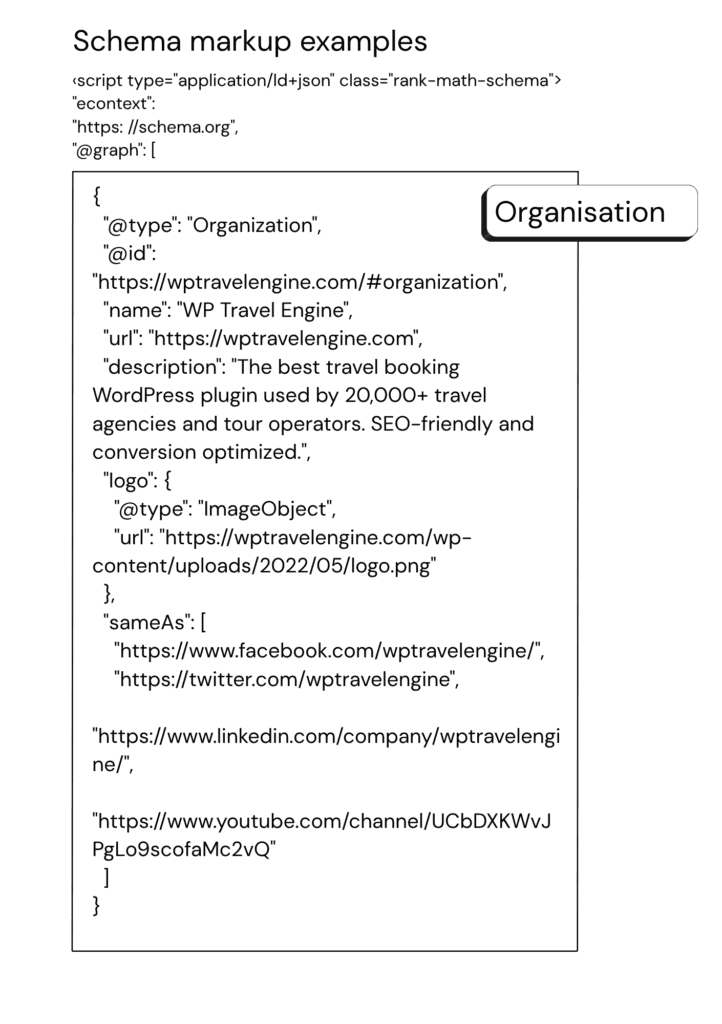
FAQPage is worth adding to any tour page that answers the questions travelers actually ask before booking, is this suitable for beginners, what’s the cancellation policy, is transport included.
These are exactly the follow-up questions an AI assistant tries to answer when a traveler asks for more details about a recommended tour.
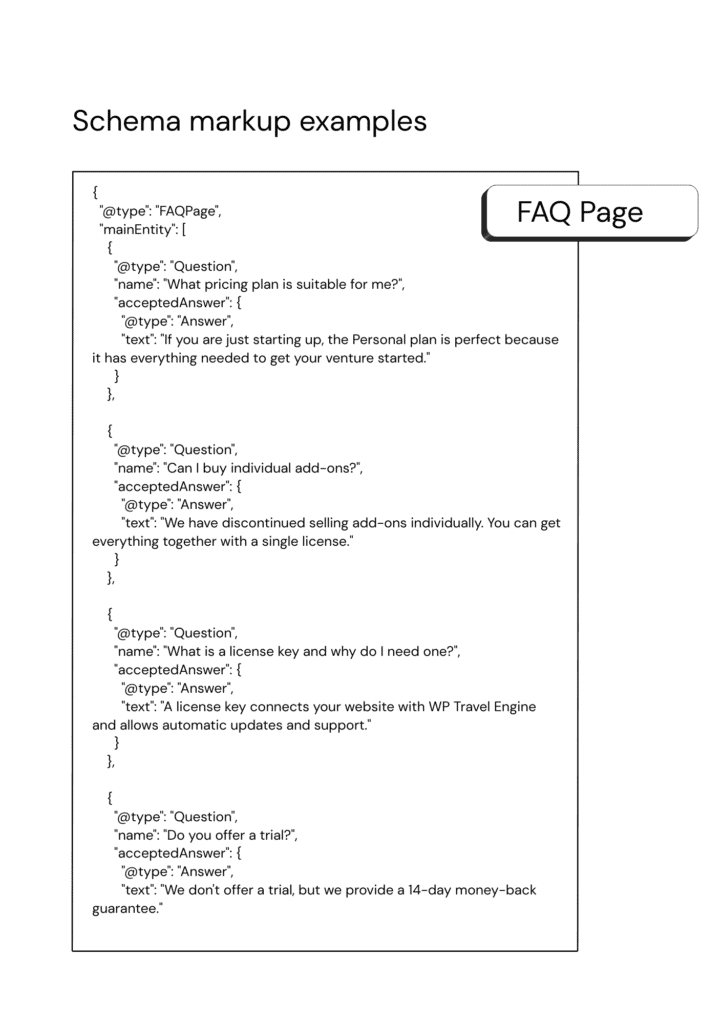
If you’re running WordPress, a plugin like WP Travel Engine generates most of this structured data automatically as part of listing a tour and setting its pricing and availability which means most operators don’t need to hand-code any of it.
It’s worth confirming this is actually switched on and current, though, rather than assuming it’s covered by default.
Common mistakes that quietly cost operators visibility
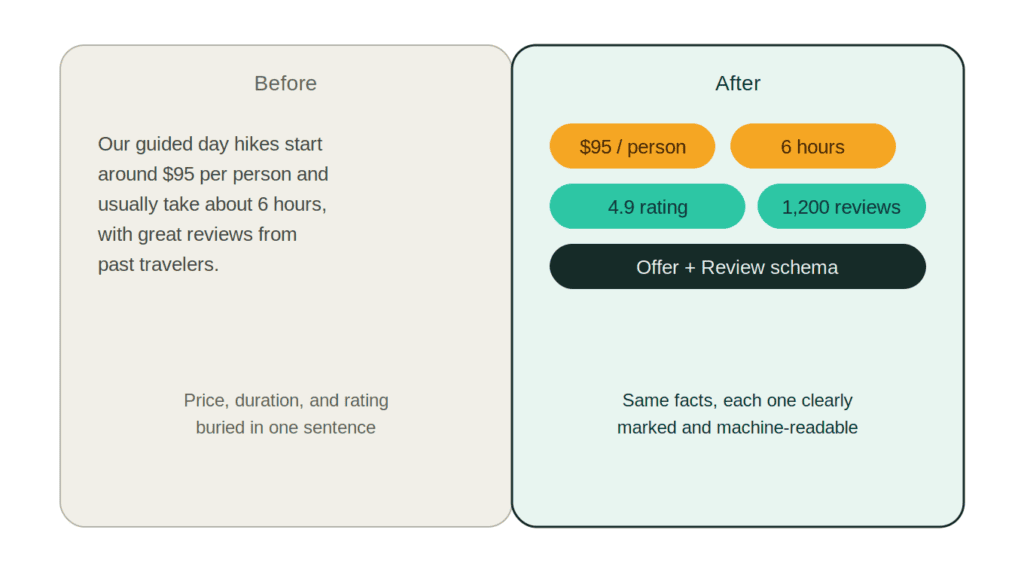
Pricing that’s only ever described in prose. “Starting from $150” written inside a paragraph can easily be missed or misunderstood.
A clearly marked price with proper Offer markup, including the exact amount and currency, is much easier for AI and search engines to understand. If your only pricing information is a sentence, there is a missing opportunity.
Reviews that live entirely inside a widget. Plenty of booking platforms and review plugins render star ratings and testimonials through client-side JavaScript that never appears in the page’s raw HTML.
A human visitor sees the reviews fine; a crawler that doesn’t execute that JavaScript sees nothing. This is one of the most common and least visible reasons a well-reviewed operator still gets left out of AI answers.
Treating your homepage as the whole story. AI engines often find and use specific tour pages, not just the homepage.
A beautiful homepage is helpful, but if individual tour pages are missing important details like duration, inclusions, or difficulty level, they are less useful. These are the pages most likely to appear in AI answers, so they need complete and clear information.
No presence beyond your own website. If every mention of your business online originates from your own domain, an AI engine has no independent corroboration to lean on — and independent corroboration is exactly what separates a confident, accurate recommendation from a cautious, generic one.
Letting seasonal pages go stale. A tour listed as “running now” that hasn’t actually operated in eight months, or a price that’s two seasons out of date, doesn’t just risk a wrong AI answer , it risks the exact kind of factual error that erodes trust the moment a traveler notices it.
Inconsistent business details across platforms. If your business name, hours, or service area differ even slightly between your website, your Google Business Profile, and your TripAdvisor listing, that inconsistency is a small but real signal working against you every time a model tries to reconcile sources.
A worked example: two similar operators, two different outcomes
It’s easier to see how this plays out with a concrete comparison. Picture two small hiking tour operators in the same region, offering genuinely comparable trips at similar prices.
Operator A has a nice-looking website, but important details are harder to find. The price is only mentioned in normal text, reviews are shown through a JavaScript-based widget, and the business has very few mentions online apart from its own website and a basic Google Business Profile.
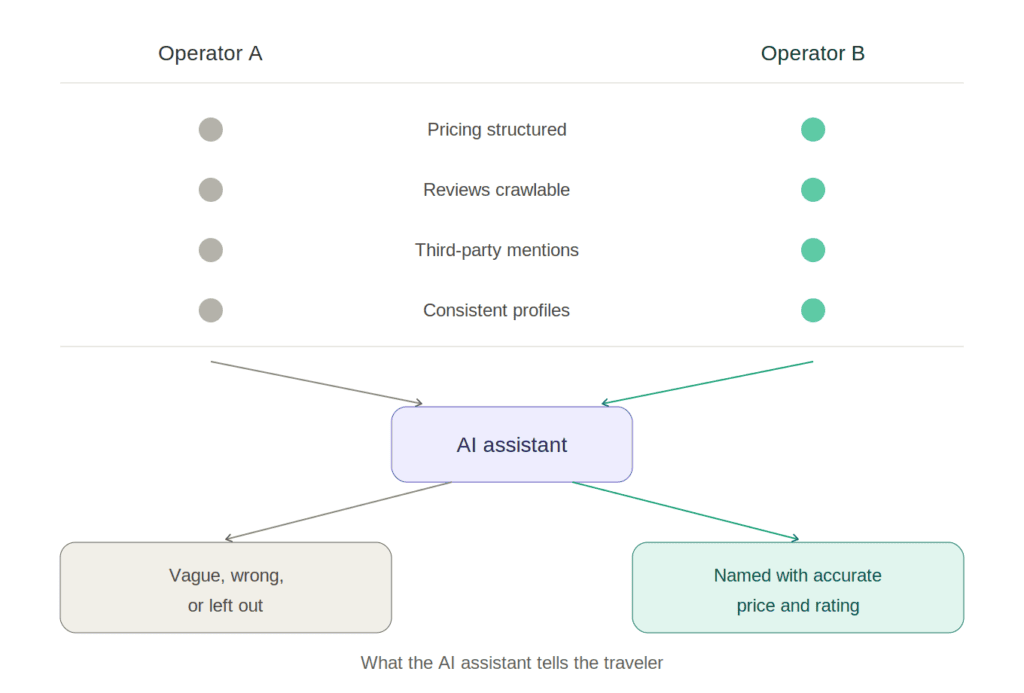
Operator B runs similar trips at a similar price, but their tour pages clearly show important details like pricing and duration using schema markup. This helps search engines and AI tools understand the information easily.
Their reviews are also marked with Review and AggregateRating schema, so ratings and selected customer feedback are visible in the page’s HTML. The business also has mentions on regional travel blogs and a complete, consistent TripAdvisor profile, which helps build trust and visibility.
When a traveler asks an AI assistant to recommend a guided day hike in that region, Operator B is far more likely to be named and named with an accurate price and a specific rating because the assistant has clean, corroborated, machine-readable material to draw from.
Operator A may still get mentioned occasionally, but with a higher chance of a vague or slightly wrong description, or left out entirely in favor of an operator the model can describe with more confidence.
Neither operator did anything unusual or expensive to get here; the gap is almost entirely in how their existing information is structured and corroborated, not in the quality of the actual tours.
Building content that AI engines actually want to cite
Beyond the technical fixes, there’s a content dimension worth addressing directly. AI engines tend to favor content that answers a specific question cleanly, rather than content written primarily to persuade or entertain. For a tour operator, that suggests a few concrete content moves:
Write a dedicated FAQ section for every tour, not just a general site FAQ. Questions like “how fit do I need to be for this hike,” “what happens if it rains,” and “is this suitable for kids?” are exactly the kind of specific, answerable questions AI assistants get asked as follow-ups once a tour has been recommended.
Publish comparison-style content where it’s genuinely warranted. A page comparing your half-day and full-day versions of the same tour, or honestly comparing your offering to a well-known alternative activity in the region, gives an AI engine something concrete to reference when a traveler asks a comparative question.
Keep a simple, current “practical information” section on each tour page; Details like the meeting point, what to bring, cancellation rules, and accessibility information may not seem exciting, but they are important.
These clear and practical details help AI understand the content better and help travelers make decisions before booking.
Avoid burying the essentials in narrative copy. Beautiful descriptions help travelers imagine the experience, but important details like price, trip length, and difficulty should also be clearly mentioned in separate sentences or bullet points.
Don’t hide these details only inside descriptive text.
Where GEO and local search overlap
For a tour operator, generative AI search doesn’t exist in isolation from local search, the two increasingly draw on the same underlying signals. A complete, accurate, and actively managed Google Business Profile does double duty: it’s a ranking factor for local search results, and it’s also a source AI engines pull from when answering location-specific travel questions.
That means the basics still matter enormously: correct categories, complete hours and contact information, regularly added photos, and prompt, genuine responses to reviews.
None of this is new advice, but it’s worth stating plainly that skipping local search fundamentals in favor of chasing AI-specific tactics is a mistake, the two reinforce each other, and a weak local presence undercuts even a technically well-optimized website.
Measuring whether any of this is working
Making a lot of fixes is easy, but knowing if they actually helped is the important part. Here are a few simple ways to track your progress:
Ask the AI engines directly, on a schedule. The simplest check is also the most direct: periodically ask ChatGPT, Perplexity, Gemini, and Copilot to recommend a tour operator in your niche and location, and note whether you appear and whether the details are accurate.
Doing this quarterly, and especially at the start of a new season, catches drift before it costs bookings.
Watch referral traffic in your analytics. Traffic arriving with AI assistants as the referring source is now visible in most standard analytics setups, even if it’s still a modest share of total visits for most small operators.
A rising trend here is a reasonable proxy for improving AI visibility, even without a perfect measurement tool.
Track which specific tour pages get mentioned, not just whether your business does. If an AI engine is consistently naming one of your tours but never the others, that’s a useful signal about which of your pages are structured well enough to get cited and a strong hint about what to fix on the pages that don’t.
Revisit after any pricing or itinerary change. Because AI answers depend on retrieval and training snapshots that update on their own schedule, a price change on your site doesn’t propagate to AI answers instantly.
It’s worth explicitly re-checking key questions after any meaningful change, rather than assuming the correction has already taken effect everywhere.
Frequently asked questions
Do I need to do anything differently for each AI engine?
Not fundamentally, the same core fixes (structured data, consistent facts, fresh content, third-party corroboration) benefit all of them. What’s worth doing is checking which engines are actually being used by your specific travelers, since visibility can differ meaningfully between them.
Will this replace the need for traditional SEO?
No. The two overlap substantially, and a lot of the same groundwork: schema, clean site structure, genuine authority; benefits both.
Think of GEO as an additional lens on work you likely already need to do, not a replacement for it.
How long does it take to see a difference?
Structured data and site fixes can be picked up by actively-crawling engines like Perplexity relatively quickly, sometimes within weeks.
Engines relying more heavily on periodic training snapshots can take longer to reflect a change, which is part of why a quarterly recheck is more useful than expecting an overnight shift.
The bigger picture
None of this replaces good service, real reviews, or a well-built website, those are still the foundation. What’s changed is that a meaningful share of travelers are now getting their first impression of your business filtered through an AI assistant before they ever land on your site.
Making sure that filtered impression is accurate, current, and favorable is quickly becoming as important as showing up on the first page of Google once was and for a tour operator, it’s a much smaller lift than it sounds, especially with a WordPress setup like WP Travel Engine already handling the structured data underneath your tour listings.
The operators who get ahead of this won’t necessarily be the ones with the biggest marketing budgets.
They’ll be the ones whose pricing, availability, and reviews are stated clearly enough, consistently enough, and in a form machines can actually read so that when a traveler asks an AI assistant for a recommendation, nothing is standing between a genuinely good tour and getting named as one.
If you’re weighing where to start, resist the urge to tackle everything at once. Pick your three or four best-performing or most-bookable tours, get their pricing, duration, and inclusions explicitly stated and schema-marked, make sure their reviews are actually crawlable, and secure one or two genuine third-party mentions for each.
That’s a realistic first pass for most small operators, and it’s enough to meaningfully change how confidently and how accurately, an AI assistant can describe you the next time a traveler asks for a recommendation.
If you’re running your tour business on WordPress, the fastest way to close most of this gap isn’t a separate technical project, it’s making sure the booking plugin underneath your site is already doing this work for you.
WP Travel Engine builds structured tour, pricing, and availability data into every listing by default, so your itineraries and rates are already in a form AI engines can read accurately, without a developer hand-coding schema for each trip. Pair that foundation with the content and review fixes above, and you’ve covered the two biggest levers in this article at once.
And see how a booking setup built for both travelers and AI search can help your tours get found and recommended before a traveler ever lands on your site.


