
Most tour operators are good at running tours. They’re not always good at the emails that happen before, during, and after. That gap costs them bookings.
Email Templates for Tour Operators help travel businesses communicate better with customers, reduce confusion, and create a smoother booking experience.
From booking confirmations and pre-trip reminders to follow-up emails after the tour, the right email at the right time can improve customer trust and increase repeat bookings.
Booking confirmation emails have one of the highest open rates because travelers are already waiting for them after making a payment. On average, around 45% of people open these emails.
But email marketing is not only about sending booking details.
For travel businesses, every $1 spent on email marketing can generate up to $40 in revenue.
The results come from sending useful emails at the right time, like reminders before a trip, follow-ups after a tour, and special offers based on customer interests, not from sending random newsletters.
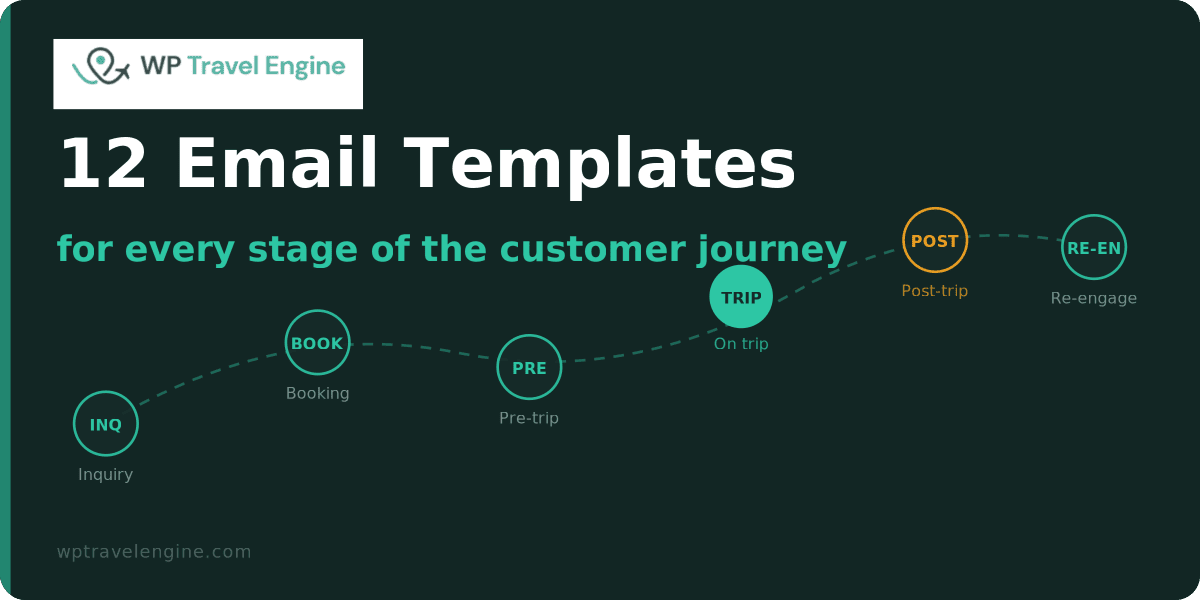
This article covers 12 templates for every stage, from the first inquiry to the post-trip follow-up. Each one is ready to use, with notes on timing and what to customize.
At the end, there’s a section on how WP Travel Engine handles the automation so you’re not sending these manually every time.
Why Most Tour Operator Emails Don’t Convert
Many tour operator emails fail because they focus more on the business than the traveler.
For example, “We’re excited to have you join us” talks about the operator’s feelings. But “Here’s where to meet, what time to arrive, and what to bring” focuses on what the traveler actually needs.
Traveler-focused emails help reduce confusion, answer common questions, and build trust before the trip even begins. They make customers feel prepared and supported from the moment they book.
The templates below are created with the traveler’s experience in mind. They focus on clear communication, the right timing, and the important details travelers need at every step of their journey.
The 12 Email Templates For Tour Operators
1. Welcome Email
Purpose Build the relationship from the first touchpoint
When to send Immediately after someone subscribes or submits an inquiry
More than 8 out of 10 people open a welcome email, generating four times as many opens and ten times as many clicks as other email types. This is your highest-performing email by default, use it well.
Subject: Welcome – here’s what we do best
Hi [Name],
Thanks for getting in touch with [Company Name]. We run [type of tours] out of [location], and we’ve been doing it since [year].
Here are the three tours our guests book most often — a good starting point if you’re still figuring out what you’re looking for:
- – [Tour 1 name] — [one sentence description + link]
- – [Tour 2 name] — [one sentence description + link]
- – [Tour 3 name] — [one sentence description + link]
If none of these fit what you have in mind, reply here and tell us what you’re thinking. We can usually point you in the right direction.
[Your Name]
[Company Name]
[Phone / WhatsApp]
What to customize: Swap the tour links for your actual most-booked trips. Keep the tone conversational — this is the first email they'll receive from you and it shouldn't sound like a brochure.2. Inquiry Response Email
Purpose Respond to a specific question about a tour
When to send Within 24 hours of receiving an inquiry
Every hour you delay, the traveler is still browsing other operators. Response speed matters more here than in any other email type.
Subject: Re: Your inquiry about [Tour Name]
Hi [Name],
Thanks for reaching out about [Tour Name]. Here’s what you asked about:
[Question or topic they raised]
[Direct answer – two to three sentences maximum. Be specific about dates, prices, group sizes, or whatever they asked.]
A few other details that might help:
- – Duration: [X days / X hours]
- – Group size: [Min / Max travelers]
- – Price: [Price per person, or price range]
- – What’s included: [Key inclusions]
- – Departure dates: [Next available dates]
To hold a spot, you can book directly here: [booking link]
If you have more questions before committing, I’m happy to hop on a quick call. My number is [phone].
[Your Name]
[Company Name]
What to customize: Answer their actual question in the first paragraph before listing the details. People who've asked something specific don't need a sales intro — they need the answer.
3. Booking Confirmation Email
Purpose Confirm booking and hand over essential trip information
When to send Immediately and automatically after a booking is completed
Booking confirmation emails have an average open rate of 45%. This is the email your traveler will screenshot, forward to travel companions, and refer back to repeatedly before the trip.
Subject: Your Booking is Confirmed – Ready for Adventure!
Dear [Name],
Thank you for booking with [Your Company Name]! This email confirms your booking for our exciting [Tour Name] adventure, starting on [Start Date].
We’re thrilled to have you on board! Here’s a quick recap of your booking details:
- – Destination: [Destination Name]
- – Dates: [Travel Dates]
- – Duration: [Duration]
- – Number of Travelers: [Number]
- – Location: [Hotel/Stay Location]
- – Booking Reference: [#XXXXX]
- – Cancellation Policy: [Your policy in plain language]
We’ve attached a detailed itinerary with all the information you need to prepare for your trip.
If you have any questions, please don’t hesitate to contact us.
See you soon!
[Your Name]
[Your Position]
[Your Company Name]
[Contact Information]
What to customize: The meeting point is the most important detail - be specific. Give an exact address, a landmark, and if possible a Google Maps link. "Meet us at the main square" has resulted in confused travelers calling at 7am.
4. Pre-Trip Reminder Email
Purpose Remind the traveler of key details before departure
When to send 3 to 5 days before the tour
Subject: You’re [X days] away – here’s what to know
Hi [Name],
Your [Tour Name] is coming up on [Date]. A few things to keep in mind before then:
- – Meeting point: [Address + map link]
- – Start time: [Time] – we recommend arriving 10 minutes early
- – What to wear: [Weather-appropriate clothing advice]
- – What to bring: [Camera, walking shoes, water, ID, etc.]
- – Weather forecast: [Destination weather on travel dates]
If anything comes up between now and the trip, reach us at [phone / WhatsApp].
See you soon.
[Your Name]
[Company Name]
What to customize: Add a weather note if possible — travelers genuinely appreciate this and it reduces the number of "what should I wear?" messages you receive the day before.
5. Upsell / Add-On Email
Purpose Offer relevant upgrades that genuinely improve the experience
When to send 1 to 2 weeks before departure
This email only works if the add-ons are actually valuable. Generic “make your trip even more amazing” language gets ignored. Write one specific add-on per email, not a list of three.
Subject: Make Your [Tour Name] Even More Amazing!
Hi [Name],
We’re excited about your upcoming [Tour Name] adventure!
Before your trip on [Date], I wanted to flag something that a lot of our guests add on and wish they’d included from the start.
[Add-on name]: [One sentence on what it is and why it matters – e.g., “A private guide for the first half-day – particularly useful if you’re arriving without much local knowledge.”]
- – Cost: [Price]
- – How to add it: [Booking link or reply instruction]
If that’s not relevant to your trip, ignore this. If it is, let me know by [date] and I’ll add it to your booking.
Best regards,
[Your Name]
[Your Position]
[Your Company Name]
[Contact Information]
What to customize: The "ignore this if it's not relevant" line reduces sales pressure and makes the email feel honest rather than pushy.
6. Customized Tour Request Response
Purpose Respond to bespoke itinerary or group tour requests
When to send Within 24 hours of receiving a custom request
Subject: Your Customized Travel Experience Awaits!
Hi [Name],
Thank you for reaching out about a customized tour. Before I put something together, I need a few details:
- 1. How many travelers?
- 2. What dates are you considering?
- 3. Is there a specific focus – [culture, food, adventure, photography]?
- 4. Do you have a budget range in mind?
- 5. Any mobility considerations or dietary requirements?
Once I have these, I can come back to you with a proper itinerary and quote within [X business days].
[Your Name]
[Your Position]
[Your Company Name]
[Phone / WhatsApp]
What to customize: Keep this email short. Get the five answers first, then build the proposal. A long detailed response before you have the basic information is wasted effort.
7. Seasonal Offer / Promotion Email
Purpose Fill low-season availability or promote a new departure
When to send During slow booking periods or when launching new tour dates
Subject: Unlock Our Exclusive Seasonal Offers – Limited Time Only!
Dear [Name],
We’ve opened up [X] new departure dates for [Tour Name] in [Month]. To fill them early, we’re offering [discount amount or percentage] off bookings made before [deadline].
- – Tour: [Tour Name] – [Two to three sentences on the experience]
- – Available dates: [Departure dates]
- – Price with discount: [Discounted price] (regular: [original price])
- – Deadline to book: [Date]
Book here: [Link]
Secure these unique offers by [Deadline Date]. Don’t miss out!
Warm regards,
[Your Name]
[Your Position]
[Your Company Name]
[Contact Information]
What to customize: Include actual capacity information if relevant — "4 of 8 spots filled" creates real urgency. Avoid "limited time offer" unless the deadline is genuine.
8. New Destination / New Tour Launch Email
Purpose Announce a new tour or destination to your subscriber list
When to send When launching a new product, before it sells out
Subject: Discover the Wonders of [New Destination] – Exclusive Offers Inside!
Dear [Name],
Get ready to expand your travel horizons! We’re thrilled to announce the addition of [Destination Name] to our tour destinations.
Here’s a sneak peek at what awaits you in [Destination Name]: [Highlight 1-2 key attractions or experiences, be specific, not generic]
- – Duration: [X days]
- – Price: [Per person]
- – Group size: [Max travelers]
- – First departure: [Date]
Special Offer: Book within the next [duration] and receive [discount percentage] off!
Full details and booking: [Link]
Warm regards,
[Your Name]
[Your Position]
[Your Company Name]
[Contact Information]
What to customize: Tell people something specific about the destination they probably don't know. Generic destination descriptions don't move anyone.

"We've been running this new route through [specific area] and the [specific thing] is unlike anything we offer elsewhere" is more compelling than "Discover the wonders of [destination]."
9. Newsletter / Travel Tips Email
Purpose Stay in touch with subscribers between booking cycles
When to send Monthly or quarterly , consistently
Subject: Unlock the Secrets of Your Next Destination!
Dear [Name],
Start your next adventure with confidence! In this edition:
- – [Tip or topic 1]: [Two to three sentences. Practical and specific, packing advice, a seasonal insight, something a guide told you that actually helps.]
- – [Tip or topic 2]: [Same format – short, useful, grounded in real experience.]
- – Available to book in [Month/Season]: [One or two tours with a brief description and link]
If you have questions about any of these or want to talk through a trip you’re planning, reply here.
Warm regards,
[Your Name]
[Your Position]
[Your Company Name]
[Contact Information]
What to customize: The best newsletters from tour operators are written like they come from a person, not a company. Use first person. Share something that happened on a recent tour if it's relevant.
10. Post-Trip Feedback Request
Purpose Collect a review while the experience is still fresh
When to send 2 to 3 days after the tour ends
The longer you wait, the less likely you are to get a review. Two to three days post-trip, the traveler is still processing the experience and is at peak motivation to share it.
Subject: We Miss You Already! Share Your [Tour Name] Experience.
Dear [Name],
We hope you’re reminiscing about the incredible adventures you had on your recent [Tour Name] trip!
We value your feedback and would love to hear about your experience. If you have two minutes, a review on [Google / TripAdvisor] makes a real difference for us – it’s how most new guests find us and decide whether to book.
[Direct link to your review page]
If anything about the experience fell short, I’d rather hear from you directly before it goes online. Reply to this email or call me at [phone].
Warm regards,
[Your Name]
[Your Position]
[Your Company Name]
[Contact Information]
What to customize: Include a direct link to your Google Business or TripAdvisor review page, not your homepage.
Every extra click is a reason not to leave a review. The line about hearing from you directly if something went wrong is important, it gives unhappy guests an alternative to a public one-star review.
11. Re-engagement / Follow-Up Email
Purpose Reconnect with past guests and give them a reason to book again
When to send 6 to 12 months after their last tour
Subject: We Miss You! Let’s Explore New Adventures Together
Dear [Name],
We hope you’re well and ready for new adventures. It’s been about [X months] since your [Tour Name] trip, we hope it went the way you were hoping.
A couple of things have changed since then that might be worth knowing:
- – [New tour or destination you’ve added]
- – [Change to an existing tour they took – new route, new inclusion, new dates]
If you’re thinking about another trip, [discount code or early booking incentive if applicable] is available for returning guests through [date].
Details here: [Link]
Warm regards,
[Your Name]
[Your Position]
[Your Travel Company]
[Contact Information]
What to customize: Reference their specific past trip if you can. "Since your Patagonia tour last year, we've extended the route to include..." is far more effective than a generic re-engagement message.
12. Partnership / Influencer Outreach Email
Purpose Propose a collaboration with a content creator or local business
When to send: After reviewing their content and confirming audience alignment
Subject: Partnering for Adventure: [Your Company Name] x [Partner Name]
Dear [Name],
We at [Your Company Name] create unforgettable travel experiences in [Destination Name]. We’ve been following your work and admire your passion for [shared interest with the influencer – be specific, not generic].
We believe our tours would resonate with your audience – [one sentence on who books you: solo travelers, adventure couples, families, etc.].
We’d like to explore a collaboration. The most straightforward option would be [hosted trip / content partnership / exclusive discount for your audience, pick one, not three].
If that’s worth a conversation, let me know and I’ll send over more details.
Best regards,
[Your Name]
[Your Position]
[Your Company Name]
[Website]
What to customize: The specific reference in the first paragraph is the most important line. Generic outreach emails get ignored. Showing that you've actually read their work takes thirty seconds and significantly improves response rates.How to Automate These Emails with WP Travel Engine
Writing the templates is the first step. Sending them at the right moment without doing it manually is what makes them work at scale.
WP Travel Engine handles the transactional emails automatically, booking confirmations, payment notifications, and inquiry responses can all be set up through the plugin so they go out the moment a traveler takes action on your site.
The Email Customizer add-on lets you adjust the layout, colors, and content of each template to match your brand. The Per Trip Email add-on lets you create different email sequences for different tours, so the confirmation email for a 3-day trekking tour includes different preparation details than the one for a half-day city walk.
For marketing emails – newsletters, seasonal offers, re-engagement campaigns – pair WP Travel Engine with a dedicated platform like Mailchimp or ConvertKit.
Pull your booking data from WP Travel Engine, segment by past tour type or booking date, and send accordingly.
Set up automated booking emails
WP Travel Engine handles booking confirmations, payment notifications, and inquiry responses automatically – no manual sending required.
Final Thoughts
Twelve templates is more than most operators use. Start with the three that apply immediately to where your business is right now — probably the inquiry response, booking confirmation, and post-trip feedback request. Get those right first, then build out the rest.
The common thread across all of them: be specific, be prompt, and write like a person. Travelers book tours because they trust the operator. Your emails are doing that trust-building work before they’ve met you.
The right email sent at the right moment recovers abandoned bookings, reduces no-shows, and brings past guests back. WP Travel Engine automates all of it — plans start at $12/month with no commission on any booking you take.


Thank you very much for providing the Email Templates that are quite helpful to enhance my knowledge for Marketing my Tour Agency Trips Nomad Adventure